Supply Chain Management (SCM) is an old fascinated marketing funda for Retail Business. Demand Chain Management (DCM) – is not something abstract. It is the real business strategy by new era business leaders. From Dell Computer to FilpCart, many new companies follow demand chain management principle. In a simple word DCM is “If customer demands then only supply”
In the 2nd half of the last decade Supply Chain Management has became the key factor for successful business. It is driven by “Supplier push” Model. In a simple example we can demonstrate that if there is a business for books (books shop), The Book Seller always have to keep 3 or 4 copies of every copy for selling. It involves large amount of money (blocked Money). Supplier had to check whether its retailer has the sufficient amount of books or not. Book may not be so demanding in the market, but producer has to produce enough number of books for the market to float it.
Demerits of Supply Chain Management over Demand Chain Management:
1: SCM involves higher investment than DCM.
2: Stocks at retail store (all level of stores) should be high.
3: Irrespective of Customer demand products will be equally available in the different Market.
4: SCM requires much higher storage space in retail shops (difficult in China or India)
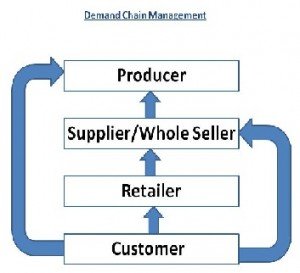
Demand Chain Management is a “Customer Pull” Marketing Principle. It based in customer demands. It is an Upstream Process. Demand-driven supply chain or network is a method for Demand chain management. The demand of the customer is passed onto the retailer, then to whole seller, then supplier and finally Producer. But for better operation some steps may be omitted. An innovative way of approaching is demonstrated by online booking, which is a very good example of demand chain management. It is the direct demand relationship between customer and Supplier or Producer. In this direct relationship there is a lot of sensitivity of the customer. Home Delivery is a suitable and mostly accepted delivery system for a customer. Different methods of Demand raising techniques are used by the company like SMS Service, Online Booking, by call Demand etc.
Demand chain management involves
(1) Integrating the demand and supply processes;
(2) Managing the digital integration
(3) Configuring the value system and
(4) Managing the cross-functional working relationships between marketing and supply Functions.
Scope of improvement in DCM: Most adopted ERP system by Oracle or SAP which works in magnificent way for many large companies have to change for DCM. There is no scope for DCM in recent ERP Module. DCM also involves high level transport system for the company. It also requires best customer service by the Company.
DCM also can be implemented in retail shopping. Taking an example of “Home Plus” by TESCO in South Korea, we can see that how DCM changed the way of shopping. In South Korea, It was impossible to open larger number of stores by TESCO. So smooth functioning of SCM was difficult. But after a great change in Way of shopping “Let the store, come to people” method was adopted. That means Customer would select from a range of products through Smart phone from public places (Ex: Virtual Stores at Subways). The total order was then delivered to the commuter’s door once they returned home from work.
After this campaign, on-line sales increased tremendously (Nov.2010-Jan.2011). Through this campaign, 10,287 consumers visited the online HOMEPLUS mall using smart phones. The number of new registered members rose by 76%, and on-line sales increased 130%. Currently, HOMEPLUS is No.1 in the on-line market and is a very close 2nd offline.” It saves a lot of time for the customer and it became a revolution in South Korean Retail Market. This is the power of Demand Chain Management.
Finally, we may dare to think that DCM the future business model for all items from retail to Manufacturing goods.
[The article has been written by Debi Prasad Dash . He is an mba from SCMHRD, prior to which he has worked in Oracle Financial Services as Assistant Consultant. ]
You might like reading:

The rise of the giant
… the threat of the imminent war was now beginning to set jitters across Kingdom “Global Giant” – On one hand it was a symbol of hope for those who believed in opportunities in Kingdom “Market”. On the other hand it also brought new fears of losses for its armies “Multinationals”, especially since it had lost a lot of sheen […]
Measuring the Impact of Social Media Marketing !
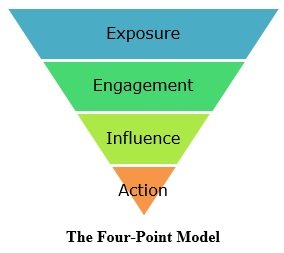
Abstract Most companies these days are taking the social media marketing route. They invest a lot of time, money and efforts in it and yet feel lost. This mostly happens because they fail to quantify the effectiveness of their campaign. This article proposes a Four-Point model to measure the impact of social media marketing by capturing various elements like exposure, […]