
There is lot of talk of value for money these days. In fact you get to hear it from every retailer that you visit. How do you actually create value and is there any limit to the value that should be created ?
When we talk about value it is all about the perception in the mind of the consumer and whether the product P satisfies his needs. There is no limit to how much value ( or rather features) which an enterprise can add to its product: the limit lies in the affordability of the product as added features will no doubt add to costs as well.If we plot the graph for this, it should look something like this:
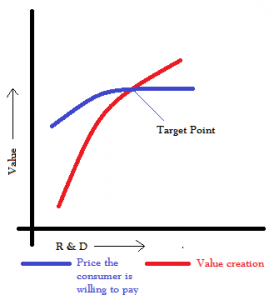
The horizontal axis indicates the development and R&D costs of the product P and the vertical axis indicates the value generated. If one analyzes the graph closely there are 4 distinct regions along the red line curve of value creation. These are:
1. The start of the Value curve( Red) : Notice the gap between the price the consumer is willing to pay for the product. The knock-offs generally lie around here in the value curve: the product development cost is minimum and returns are high.
2.The middle of the Value curve : This is the region where most players in the region lie. The R&D investments are substantial and sales are also good, however the products are not path breaking.
3.The target point: This is where the price and value meet. It is the ideal place to position a product in the market. Great sales are always a characteristic for players in this segment. Apple IPhone can be regarded as a product lying at this point right now.
4.The end segment of the value curve: This is the segment which constitutes absolute maverick firms. These firms invest substantially in development and are always looking to deliver to markets for the future. However care should be taken that the product is not too advanced, otherwise the benefits are reaped by another player in future. For example, the first touch screen phone,Simon, was built by IBM but no one hardly knows about it.
The nature of the price curve (blue) should also be studied carefully and it is noteworthy that consumers are not willing to spend beyond a point as can be marked by the flattening of the curve.
Food for thought: How much value do you build to your product ?
You might like reading:
Rouble Trouble: Russian Rouble Crisis & How to Solve It…
The year 2015 doesn’t seem to bring much good news for the Russian economy as the rouble crisis continues in the wake of staggering global oil prices. If this trend continues, Mr. Putin is facing an imminent threat of both recession and internal inflation, similar to something that happened in 1998. All events that have happened in the past year […]
Analysis of Tax reforms in Budget 2015
Proposal to reduce corporate tax from 30% to 25% over the next 4 years increase indirect tax. Implications: The proportion of tax payers is low in India and the black money is one of the major issues hindering the growth in India. So to have a better control over black money, government has reduced the corporate tax and is increasing […]