
“Hospitality industry is the largest and the rapidly growing industry in India. The competition in this industry is very high and it also faces lots of challenges.”- S.K.Kuthiala
“Low level of training, low wages, high level of temporary workers etc are few issues that exist in the hotel workforce. To retain its customers and attract other customers from its competitors the organisation needs to improve its customer satisfaction. For this, it takes effective and motivated employees at the delivery end.”- A.Kulkarni and V.Umashankar
According to Baron, motivation is an accumulation of different processes which influence and direct our behaviour to achieve some specific goal. Motivation makes the person to behave in a specific, goal-oriented manner. One can be internally motivated (intrinsic) due to the interest in his work, the satisfaction that he is feels by doing the task. The other way to motivate a person is by offering a reward, challenges etc. which is an external mode of motivation (extrinsic).
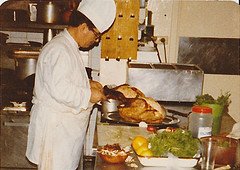 |
| chef (Photo credit: StuRap) |
[The article has been written by Saurabh Kumar. He is an MBA in Marketing from Institute of Management, Nirma University. He is also involved with “Saral”-NGO which works for the children of construction workers and writes his own blog in his spare time.]
You might like reading:

Will the Volcker Rule work?
The Volcker rule, the centre piece of the benchmark “Dodd-Frank Act”, was passed in December this year and is widely expected to impact financial institutions all over the world and particularly the US. Named after Paul Volcker, the former Fed Chairman, the act reinstates many provisions of the erstwhile Glass-Steagall Act. The Background The Glass-Steagall Act of 1933 was […]
Co Branding: Effective or a damp squib ?
The other day, as I went in to buy a new watch at Shopper’s Stop, I was a bit overwhelmed by the sheer number of advertising gimmicks being employed by the companies. At the purchase counter, I was greeted by a First Citizen Card Membership, which made me eligible for discounts for a whole lot of other brands like Barista, […]