
In the mid 80s, lots of companies went for vertically integrated setups.The main criteria for this choice was to have more control over the delivery time and margins. It was indeed the need of the hour at that point of time. However with the rise of cut-throat competition ,fluctuating exchange rates and lowering margins, is vertical integration still advisable or alternate models need to be explored ?
Let us consider the present condition in the making of a product having three distinct departments/ processes A,B and C.
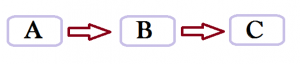
Yes it makes a lot of sense to have all three operations under one proof and consider the overall profitability of a firm as a whole, but what about the profitability of processes A,B and C? What if any particular of these processes is not doing that well? after all your overall profitability is a function of the sum of profits of A, B and C.
So your basic focus should be to increase profitability of your individual processes. It is here that I suggest the decentralized model.
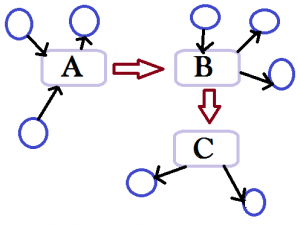
In the decentralized model, though A, B and C are processes in the same firm, they are free to take orders from other competitive firms and also outsource their work to other firms if they find their corresponding process to be more expensive and/or less efficient. The blue circles here indicate the vendors and clients they are working with, the inward arrows indicate the booking of an order and outward arrow indicate the outsourcing of an order.
It will lead to the following advantages:
1. More efficient systems– When each of your processes will work as profit centers and will compete with each other for orders, that will definitely lead to higher efficiency.
2. Individual profit targets– Since each of your processes will act like an individual unit, each will have its own goals thereby leading to profit maximization.
3. More competitive pricing– with greater control in the costs incurred, your product will definitely have a greater chance of success and will be able to compete more voraciously in the market.
4. Creating incentive plans– share profits with employees on the basis of their department’s profitability, which will definitely provide a greater return to you in the long run.
5. Handling recession- In times of recession, it will be a great boon to keep you moving as you may not be having more orders, but others will definitely use the efficiency of your processes, thereby enabling you to at least operate on no loss basis.
Food for thought: Can HR be a profit centre ?
Tags: advantage integration opportunities You might like reading:
One stop destination for apartments- Homesathand.com
Interview with Mr. Bhaskar R, Co-Founder, homesathand.com Q1. Firstly, a very warm welcome from Ideasmakemarket.com team. Tell us something about your background. I completed my MBA in 2009 and was heading research operations with a boutique market research firm in Bangalore. Late 2013, we (along with 2 other partners) launched Zrotra (meaning divine knowledge in Sanskrit), a research and advisory […]

IMM Comics: The order gets…
Our MBA guy gets his first task- securing a difficult order! Does he succeed or does his bad run continue ! Let’s find out : Food for thought: Was the experience similar for you in your job? Tags: office life