
How often have you told the truth in an exit interview? A survey result shows that almost 90% of employees leaving an organization give very positive feedback and never disclose the true reasons why they are leaving. And this reason alone makes exit interviews a waste of time.
Taking a cue from scientific management, exit interviews were installed in most HR processes across corporates. The objective was to get a feedback on why the employee was leaving. This was also a last effort to retain the employee and also to take corrective action if too many employees are citing the same reasons.
But today they have become tick marks, one more step in a process that has neither value or any success. I feel that exit interviews are more like post mortem, which will let us know sometimes about the reason why the employee has terminated his relationship but will never be acted upon so the causes remain.
Let’s take a step back and see why employees leave organsiations?
According to Leigh Brahnam who wrote the book, “The 7 Hidden Reasons Employees Leave,” the top seven reasons employees leave are:
- The job or workplace was not as expected
- Mismatch between job and the person
- Too little coaching and feedback
- Too few growth and advancement opportunities
- Feeling devalued and unrecognized
- Stress from overwork and work-life imbalance
- Loss of trust and confidence in senior leaders
Also in my opinion people leave their managers and never the organization. Often I have seen that it is easy to leave the company rather than to change their departments or move to new roles within the company. It may be interesting to note that monetary reasons do not feature in the top 7.
So once the employee has made up his mind and starts floating his resume, there is little that anyone can do and the Exit interview tends to be a waste of time.
I think the best time for intervention is before the feeling of stress and uncertainty sets into an employee. This is given by the Risk and Uncertainty Model given by Prosci please see the diagram below.
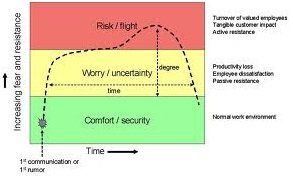 |
| (Source: www.changemanagement.com) |
The intervention from the management and HR has to come before the employee enters the red zone. Once an employee is in red there is little chance that he would stay back in the organization.
Unless organizations are serious about retaining employees exit interviews will continue to be a tick mark and are a sheer waste of time.
You might like reading:

Strategy insight : How to win a war
Winning a war is not merely about deploying forces and engaging in combat; it requires meticulous planning, strategic thinking, and effective management at every level. From ancient times to modern warfare, successful military campaigns have been marked by sound management principles, adapting to changing circumstances, and utilizing resources efficiently. In this article, we delve into the intricacies of managing a […]

Quest to engage employees ! – A mirage
“Engaged employees stay on for what they give, the disengaged stay for what they get!!” The quest to “engage” employees is like a mirage in the desert on a hot summer day. It is what the traveler (who personifies the employer) yearns for, but the closer he gets to it, it seems to elude him. Employee engagement is the […]