
Microsoft is one of those rare companies that Jim Collins refers as “Great by Choice” in his book by the same name. In fact, Microsoft was the only company to realise the importance and market for software in the age when IBM was the dominant player and a young Apple Computers was still making its way. Today Microsoft stands as one of the leading companies in the world with revenue of 73 billion USD in 2012.
However, while it was strengthening its position as a software leader, it suddenly decided to concentrate on hardware business as well. This was largely due to the resurgence of Apple after the return of Steve Jobs along with the increasing popularity of open source OS. Microsoft launched several hardware devices starting with mouse and keyboard but none as popular as the Xbox, the gaming console. With the launch of Xbox in 2002, Microsoft was now directly competing with industry leaders like Nintendo and Sony, foraying into an unknown territory. Its latest version of Xbox (Xbox 360) has been performing significantly good with 76 million units sold and ranks second next only to Nintendo Wii U which is close to 100 million unit sales. Moreover, it no longer positions it as a gaming console alone but as an entertainment device with accounts for users, a practise that has marked an increase in the number of hours a user uses the device leading to direct impact on increasing sales.
However one recent law passed in South Korea now threatens the efficiency of this strategy. A major consumer base for Xbox consoles and Xbox Live is the Kids market. South Korea recently passed a law that blocks kids below 16 years of age from accessing gaming portals. Dubbed the Cinderella law, the law prevents kids from using portals for a period of 6 hours a day affecting directly online services like Xbox live and PlayStation network. Unfortunately for Microsoft, the impact of this ban will not be limited to gaming consoles. Microsoft has integrated Xbox live in its new OS – Windows 8 and is one of the main drawing features for the platform, being used both in the mobile & PC-Tablet segment and if such a law is passed by other countries, it can directly impact sale of Microsoft products in future. Out of 90 odd countries, where Xbox live service is available, South Korea is so far the only country to have passed such a law but European countries are also expected to follow suit in near future.
Microsoft has started positioning itself on the lines of Apple Computers, integrating hardware with software. The launch of Microsoft Surface is a clear indicator in this regard, a product that has still not met expectations. However, unlike Apple, Microsoft allows third party vendors to use its platform thereby separating its hardware and software businesses. In case of mobile devices, Microsoft has been trying to use its leverage with Nokia with its Windows 7.8 and 8 platform. However Android appears to be a clear winner in this battle so far. In case of search engines, its tie up with Yahoo has so far not been able to impact the market share in search engines for Google.
So with all these problems, where is Microsoft actually heading? If we consider each of these arenas separately, it suggests a gloomy picture. However, if we combine each of these areas and look for strengths in a single entity, then you get signs of a company that will remain significant in times to come. But even IBM was a powerhouse in its days of glory, will Microsoft head a similar fate? A key stake in Facebook and would be stake in DELL allays such thoughts at least in near future. Here’s hoping it doesn’t repeat the mistakes IBM did!
You might like reading:

Tete-a-tete with Abhishek Agarwal, Co-Founder, Bold Kiln
Bold Kiln is a company, co-founded by Ankit Pandey and Abhishek Agarwal, that enables start- ups to develop into full-fledged businesses by providing an array of services that anyone who decides to take on the entrepreneurial route might find themselves in need of. We caught up with Abhishek and tried to find out more about his journey. Q1. Firstly, a […]
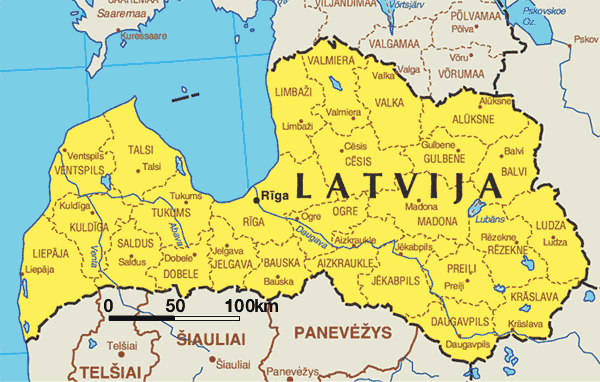
Why is Latvia adopting the Euro and joining Euro-Zone?
As a country that has seen its fortunes swing in quick period, Latvia is again on the verge of creating history. On March 4th, 2013, Latvia formally applied for adoption of Euro as it currency. The origin of Latvia dates back to 8th century A.D. and owes it to Latgalians, one of the four ethnic Baltic tribes and from which […]