In a hyper competitive market where the basic feature of almost all the products is the same, the focus inevitably shifts to price. Price is an important vehicle for capturing customers from the rival product’s consumer base. It also becomes an important source for penetration of new segments.
A consistent and sustained
marketing on price inevitably generates expressions from consumers like, “I think they are the ones who offer maximum value for money “, or like “I think they will continue to be priced lower than others.” While at an initial phase, there is a bit of skepticism over the quality of the product owing to the lower price of the product, consistently marketing it as a discount brand and delivering value to the consumer – leads to the phenomenon of “
Price leadership“.
Let us consider a simple example. Let A be the market leader and B be the new consistent discount player. Over a period of time consumers are bound to shift to B, because B offers the same product at a much lower rate- while A does retain its initial advantages of economies of scale and scope, it is bound to follow B at some point of time by lowering its prices in order to retain market share. But how does B deliver its product at a consistent discount over others?
The very initial strategy of any discount player is to differentiate a product into two distinct segments: necessary services and peripheral(or additional ) services. The next step is to focus on just the services needed from the product by a vast majority of the consumer base and eliminating most of the peripheral services thus reducing their overall costs and providing them the scope to ensure greater discounts. For example, the basic focus of Air Deccan, the discount aviation player in the Indian skies just focused on one simple thing: Making the traveler reach his destination. Unlike other players who focused on the quality of service offered to consumers, Air Deccan just focused on the need for flying: No free meals, No great support staff and little inflight support. What it led to is Air Deccan was offering fares as low as INR 1000 at a time when the market leader (Jet Airways) was offering fares in the tune of INR 5000 for similar travel. Such a strategy quickly led to Air Deccan emerging as the pioneer of low cost flying in the Indian skies.( Air Deccan has now been acquired by Kingfisher airlines and no longer operates as a low cost airline)
Overall the strategy of the discount player is 3 phased:
Identify the area of need–>Reduce costs by reducing peripheral services–>Offer discount and act on the lines of cost leadership
The question of a perceived lower quality owing to discount is important here. Often consumers tend to believe that a higher quality product is priced higher. The discount strategy product does not claim to be a better product than the high priced product, as it is stripped of most of the peripheral services that the high priced product offers. But it still succeeds because it concentrates just on the services that are needed and hence due to its narrow approach, it creates an increased focus on those parameters, which have been deemed important to the masses,allowing for an improved service in those areas. A clear example in this regard can be the example of Big Bazaar, the Indian discount retail chain. When it first started the concept of discount retailing in India, it was perceived to be supplying defective products. Today it is rated as one of the best retail chains in India with an extremely efficient supply chain and a host of private labels of its own. How has that been possible? The answer is simple- it focused on its priority: Delivering at the lowest price to the end consumer.
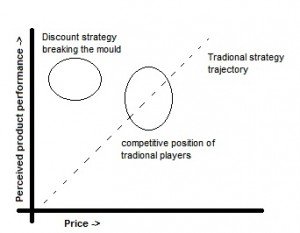
If we tend to compare graphically the strategy of traditional vs discount players, it will look something like this:
The traditional players in the market normally tend to increase perceived performance with an increase in price, whereas for a discount player the focus is on increasing performance with no increase in price. That is the major difference in approach in the two strategies.
So how can a product be better when it has little additional features? So if the product is not better, how can it be a market leader? The discount product might not be better in the strictest sense of the term, but it is undoubtedly better or equal to traditional products on specific key product or service features. That’s the secret to its
success : Value for money ! As long as it continues to do so, it will remain a force to reckon with in the competitive market.