
Recently I attended a seminar where the guest speaker was Mr. Ridham Desai. Mr. Desai is Head of Indian Equity Research team at Morgan Stanley, India. Reflecting on his comment – “Grandmother of bull runs is yet to come”, I decided to do a small analysis to cross check his claim. Yes, this is a little presumptuous on my part. However in the interest of my “limited capital”, a little validation was worthwhile.
The data point is from 2000 onwards. To begin with, my focus has been on the most basic multiple – P/E. Look at the below chart. The red circles show the peak P/E reached by SENSEX during each of the bubbles (i.e. tech and subprime crisis). The number hovered around a mind numbing 28x. Comparing this to the current range (since the last 2 years, SENSEX has been trading in a broad range of 18-20x), if we consider the long term horizon – the rally still has a lot of leg.
Chart 1: P/E movement
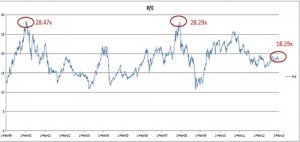
Source: BSE India
The next analysis is a cumulative comparison of P/E, P/B, Div Yield and Nifty movement. This analysis does not help ascertain the inflection point (personally I am not insightful enough to notice one). However, it surely helps ascertain the GAAP and GARP concept discuss by Mr Desai. If you observe the graph (below), there was a long period when the Nifty/SENSEX traded below their respective book values. This is as recent as 1999-2002.
Chart 2: Cumulative
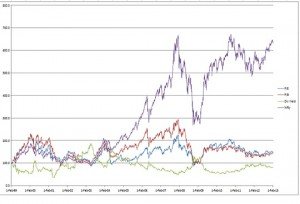
Source: BSE India
Inference – Even my grandmother could make money in the markets. Jest apart, this was surely one Inflection point.
However, coming to more recent times, it is interesting to note the P/E and P/B movement from 2008 to 2012. During the 2008-09 crisis, the prices went on climbing without actual change in fundamentals. The companies earnings did not keep pace with the rise in price. It was an actual situation of – “Buy on rumours and sell on NEWS” – or maybe, not sell at all!
However this time around, specifically the period from 2011 onwards, the prices have inched up but the P/E and P/B has not. Using simple mathematics, it is easy to determine here the increasing earnings and rising book values – a clear indication of corporates strengthening their balance sheet and tightening their belts.
However, coming back to our core discussion – I personally feel, the market is in a consolidation stage. Do not look at the absolute figure. It does not indicate “value”. I would rather look at P/E and P/B to get a better picture of where the broader market stands. Currently, we are in a side-ways movement scenario. When this will turn? – I am too naïve to comment. But when it does turn, it will take a lot of people by surprise.
So vindicating Mr. Desai’s claim, the ‘Grandmother of bull runs is yet to come“.
[The article is written by Mr. Varun Joshi. He is the Managing Partner of AV Realty Corp. and is a keen follower of Indian equity market.]
[The article is written by Mr. Varun Joshi. He is the Managing Partner of AV Realty Corp. and is a keen follower of Indian equity market.]
You might like reading:

Capital Gains – when and to what extent are they exempt from tax
The Income-tax Act grants total/partial exemption of capital gains under section 54, 54B, 54D, 54EC, 54F, 54G, 54GA and 54H. It is possible to avail of multiple exemptions under these sections. However, the aggregate amount of exemption cannot exceed the quantum of capital gain. In this article I shall be explaining exemption of capital gains under section 54, 54EC & […]
Study on the Oral Care industry in India
Most of us, after getting up in the morning, have been consciously or unconsciously reaching out for a tooth brush and a tube of toothpaste for many years now. Brushing is so much a part of our daily set of activities that it can now be considered a habit. It’s this habit that gives rise to the global oral care […]